Tuesday, 19 November 2013

Representations of social class - Shameless


1.) Discuss the ways in which the producers construct representations of working class in the opening credits through the 4 micro-elements.

-Camerawork;
-Mise-en-scene;
-Sound;
-Editing;
You should select 10 frames minimum to screen grab as examples for your analysis. I expect 700-1000 words.


     The start of the clip has a soundtrack in the background which is quite happy and peaceful to create humour for the audience as this is a comedic programme. Using this happy music is intended to make the audience feel more relaxed as if this isn't really what happens in families like these, or it is but this has been exaggerated for their entertainment.


     The opening scene begins with three jump shots of high rise tenement blocks which represents a council estate. This tells us that the main setting is going to be here as they must be significant to the storyline if the scene opens with images of the flats. These are usually thought of as being dirty, not very well looked after and full of families with no job, taking drugs and alcoholics. In the voice over by Frank Gallagher himself, we learn that he is very happy living on this estate as he refers to it as 'being a good home for us'. 


     The social class being represented is of the working class and I know this because of the 'estate' they live on as well as the many children from different mothers that Frank Gallagher has in order to receive more financial support from benefits. The usual stereotypes associated with the working class in the media is that they are from an uneducated background, live on council estates, have large families, alcoholic father which is also shown in Shameless. The mise-en-scene here shows them all to be wearing very dirty looking or old clothing, possibly have been passed down to one another to save money but also, they wear things like tracksuits which are generally associated with council estate families as they can't afford all the latest fashions. 
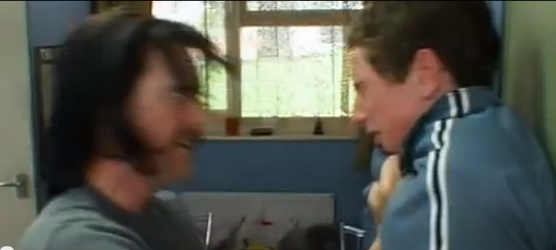


Another common stereotype is that people who live on council estates don't have a lot of money however, they can always afford to buy cigarettes and alcohol which then makes them behave aggressively even towards their own children. This was shown in Shameless when their was a close - up of Frank holding his son by the collar and looking as if he is about to hit him. This is not a good representation of the working class however it is very stereotypical. There is a close-up here to show how frightened his son is of him which sums up their whole father son relationship.


The producers have used an image of most of the children together to emphasise the amount of children these working class people have in order to gain more benefits to pay for their drug/alcohol addictions. They can't be a very close family as this is the only image in the scene with most of them together however, Fiona is missing from this one. It usually tends to be all the children look out for each other but the parent does their own thing and shows no parental guidance or love.


Frank has shaved his sons hair because he says that he gets head-lice although to an audience who watches this, it will create an image in their head of him being part of a gang where they all look the same. It could also be presented as they don't have enough money for shampoo etc. Lower class citizens are usually seen by the upper and middle class as being dirty and that could be another reason for the decision to shave his hair off.


The dad, Frank can't be relied on as he is always drunk and seen to be lying on the kitchen floor after not having brought home any butter or other food items to eat with the plain bread. He is clearly an unfit father figure although to the audience, it seems like a joke that a father would be like this so they laugh. This birds eye view shot shows us that he is not a responsible dad and even his children find it difficult to respect him because of his behaviour.


Setting cars on fire are presented as being a party for these lower class citizens as they must have nothing better to do with their time. This is also a stereotypical view on the social class as they like to cause mayhem by having parties etc.


They are typically thought of as thugs which is also shown in this clip when they are throwing things at the car, huddled together as if they are in a gang and being very loud. As the police arrive, we see a clear binary opposition between the police and the residents which also represents the social class and how they are thought of by the other classes.


They appear to love it when the police come to break up their parties because it makes it more exciting for them. Typically, people from council estates try to avoid the police as they are prone to getting into trouble however, this is not the case here. Instead Frank thrives on the fact they have joined them. As the police arrive there is a diegetic sound form the sirens which emphasises the chaos these social class people are creating.


The name of the show can symbolise many different things. One interpretation is that it could be based on Frank's character because he is not ashamed of the things he does and the way he behaves. A long shot has been used here to capture the extent of the damage they have caused as well as the chaos created by the entire estate.


     The overall representation of social class is shown as being very low due to the editing of jump cuts at the opening of the programme to show the council estate and how significant a place like that is in their lives. The mise-en-scene clearly represents them as having very little money as the children are always wearing a tracksuit and they never look clean and neatly presented. There is a soundtrack which coincides with the narration of Frank Gallagher to show his love for his family as he sounds extremely happy with his life even though he doesn't have a lot. There was a panning shot at the beginning to show the extent of their estate which isn't a lot. Frank uses a biblical term and says it's 'no garden of Eden' which shows he is aware it's not a lot but it's enough to make him happy which happens quite a lot in the social class. They are generally happy living in a neighbourhood where they all get on and are like one big family,

Ashes to Ashes Exam Question


1.) Analyse the ways in which representations of gender are constructed in the extract through the usual 4 micro-elements.

At the beginning of the extract, Alex Drake is wearing a suit with her hair tied up for practicality and professionalism. This is a turn around from the usual representations of gender as it is usually the man who is shown to be going to work and wearing suits etc. Alex Drake then begins to drive at a high speed in order to arrive at the crime scene which again isn't the normal representation we expect to see of a woman. As the times change and she wakes up in the 1980's, she appears to be dressed as tat of a prostitute with a tight, short, leather dress which Gene Hunt comments on by saying 'If that skirt was hitched any higher, I'd be able to see what you had for breakfast'. This implies that she is dressed provocatively and in a way that makes men look at her as she is revealing her body. The colour red of her dress and the bright red lipstick symbolise a seductive image. This is a completely different representation of women compared to the opening scene as they are now being presented as flirtatious, going out of their way to make themselves get male attention and the men are presented a respectable by Gene Hunt's comment to her about it and appearing not to be interested enough to stare at her. As the man in the grey suit chases after Alex Drake, they end up in what looks like some sort of closed off area which would normally be where a prostitute would have picked up men in those days. In this scene the man is being confrontational, preventing her from moving away. He treats her like someone with no importance, like she is nothing which would not have happened in the modern day when she was a respected police officer. 

The sound used during this scene was a soundtrack as the car entered what looked like a car park to symbolise the importance of the police officers arrival as they are all men and they are in control. There were sounds from the exhaust of the car as it drove speedily around the corners before stopping which also exaggerated their power as their entrance was so significant that Alex and the man in the grey suit stopped and stared. The soundtrack and the car present the men as being very masculine. Men from the 1980's appear to have the same respect that Alex Drake had in the modern day. 
Alex's shoes make a diegetic sound as she walks or rather is pushed against the wall by the man. This really points out that women are easily pushed around by men as they are in control. As Gene Hunt delivers his lines, he appears to be very macho with his head held high and every word he uses presents him with the utmost authority. Alex Drake's speech when she is telling the man in the grey suit what the officers want shows her intelligence which would not be the normal representation of women who are put int hat position. There were no special effects in this scene whatsoever.

When Alex Drake is looking in the puddle, there is a reflective shot which is there to show her emotions which presents women as being emotional and not afraid to show their feelings. The editing of this extract showed a low angle using the 180 degree rule to emphasise the hierarchy and power men have compared to women. The major reveal of the police officers has a close up on Alex's face when she discovers who they are. This shows her intelligence as a woman which is another representation of gender here seeing as the man in the grey suit needed Alex to explain what the police officers wanted to make him give himself in. This scene uses many different angles to show the degrading view on women dressed as a prostitute with a long shot as well as the knowledge and professionalism of a woman with a low angle. 


Tuesday, 12 November 2013

Ashes to Ashes - Remake


Ashes to Ashes - Remake 


     We worked in a group to recreate the scene from ashes to ashes. I have placed the video in the corner of the video to show the real scene and our version is next to it. Although it is not exact and there are many mistakes, we got a real understanding of how difficult it is to recreate something with all the intricate details, especially without a shot list.


Representations of women in the media - Documentary


Representations of Women


     I have put together a documentary to show the representation of women in the media. This includes a clip from the film 'Legally Blonde' and the fairy advert to convey the stereotypical views of women which are thought of because of their portrayal in the media.


Wednesday, 2 October 2013

Continuity Task


 In this task we were trying to get some continuity so that our shots would flow from one to another. This can also be called invisible editing. We also attempted something called match on action which is the cut between two shots without it looking like time has passed between the two shots taken. This is important when continuing the flow of a scene.
We also used the 180 degree rule which was whilst we were having a conversation.
This rule involves using a shot and reverse shot to capture both the characters in the scene and focus on one of them at a time.


This is an example of my use of match on action


This is what my timeline looked like on Final Cut

left it from the previous shot. This is important to continue the flow of the

Tuesday, 1 October 2013

Home Learning


Enemy of the State, Tony Scott, 1998


     The point of this sequence is to not only build tension to the audience but also to keep us in suspense. Tension is created through the editing of this video by using a lot of close ups and by cross-cutting between the men inside and the ones outside who are going to be causing trouble.


This image represents a close up which I believe shows the significance of this being put into the machine. It is clearly an important part, otherwise there would be no need for the audience to see it. They are primarily used here to put an emphasis on the importance of each close-up and draw our attention to them. This adds to the tension being created as we start to think about the story behind it and begin to wonder if the people outside are after what this man is placing in the machine.


They then cross-cut from one scene to another to show the audience that something is going on and by the look of the men, it's not a good thing. It appears that they are after what they have. The editing that was done for this video was very well done because their speech ties in with the edit. The man says "It's a brave new world out there, at least it better be" then the camera changes shot from a close-up of a family picture to a long shot of the men to show they are distant but they are on their way.

The first shot from 1:03 of the video was a close-up of one man handing over a device with some sort of memory card in it to the other guy. Then it has the same close-up of him removing this card from the device. This helps the audience to understand that there is some importance of this as they clearly wanted it to be seen. It then cuts to a mid-shot of the two men whilst he turns in his chair to place the card into a machine. The significance here is still that card which must be the main focus in the storyline. This reassures the audience that it is important that they have noticed it and must see what they are doing with it.

They then cut it to an individual close-up on each of them one at a time depending on who is speaking to signify that they are not only the main characters of that scene but also to understand their emotion behind what they are doing. It shows this close-up so that you really hear everything they are saying as that is just as important as the memory card. As the man removes the card from the machine, the close-up is back on his hand to symbolise that they have finished doing what they needed to and they now have all the information for the computer system. 

Lastly, they take a mid-shot of both the men whilst he swivels back to the desk and places the card into a machine linked to the computer. This is done using a close-up again. This backwards and forwards of editing between close-ups and mid-shots guarantees that the audience wont miss anything and that they can see what the important parts are. This builds the tension for the audience because they will wonder why that card is so significant.

The editing of this sequence really fits in well with the theme of a thriller because the editing and camera shots has created a lot of suspense and tension for the audience and that makes it very fascinating to watch because you want to know what will happen next. The men outside make it a little bit creepy which also relates to a thriller theme as it keeps you engaged in the storyline.

The use of cross-cutting really creates tension because we have seen so many close-ups of the characters already which means we have more empathy for them. This makes us want them to be safe as we have seen how closed in they are in the room.


Representations of Gender: Dr Who (Gender)


In this clip, the representation of me and women are very different however, they clearly represent the stereotypical male and female roles that have existed for years. 
Clearly in this extract, the man has the power which is very common in the media as men are more dominant, active and stronger than women so they are usually represented as having complete control. In this case, there has definitely been a connection here. 
Women on the other hand are represented entirely differently. They are seen as being submissive, soft and passive. They prefer to talk things through rather than take action which is also shown in this clip. Women are also usually seen to be in love or have a relationship which in this video is shown when she says 'I love him'. The woman is always shown to have the feelings as they are said to be more sensitive.

     
The use of camera angles in this scene are very clear in representing the man as dominant by using a low angle which makes him appear inferior to the other characters and it's obvious he has the power. 


Also, the use of a high angle on the girl makes her feel belittled. The use of close-ups makes us empathise with the girl because we really gather an idea of her emotions by her facial expressions which are mostly captured in those close-ups. 


There is a use of reversal in this extract to track the conversation between the man and woman. He starts off at the top of the stairs to show he's in power and inferiority towards the girl. The man always has the woman in the red dress behind him which represents feminism due to her beauty and her physique.  


They also used close-ups and long shots to build up tension and create suspense.


The mise-en-scene in this clip is quite intriguing. The costumes really develop our understanding of the characters roles for example, the woman in the red dress and the man being in a suit clearly indicates a sense that they have the control and are of higher authority than the lady in jeans and a casual jacket. Also, the guns that were used as props build up tension as the audience begin to worry if someone will get injured. The countdown clock used as part of the set was another tension builder as we could feel something bad was going to happen when it got to zero. They regularly showed the image of the clock to keep the audience in suspense. 
The scenes were edited and put together as it starts off in a big open space but they use flashbacks to separate the reality and what she had previously experienced. They did this using a straight cut. 


Camera Angles & Camera Shots - Early Edit


Camera Shots & Camera Angles

     In our last lesson, we filmed ourselves experimenting with different shots and angles. We then had to put the video together using 'Final Cut Express' and then did a rough edit of the video adding text to describe what kind of shot it was. 


Here is the video I created: